National Peace Officers Memorial Day

May 15th is National Peace Officers Memorial Day, part of National Police Week. Throughout this week we take time to honor those men and women who have lost their lives in the line of duty. An estimated 20,000 officers, family and survivors will attend the candlelight vigil and ceremonies this week at the National Law Enforcement Officers Memorial. Many more will honor their fallen in personal ceremonies all around the country.

Established by a joint Congressional resolution in 1962, President John F. Kennedy proclaimed May 15 as National Peace Officers Memorial Day and the week that it falls as National Police Week. Dedicated in 1991, the National Law Enforcement Officers Memorial in Washington D.C. consists of two 304-foot blue-gray marble walls with the names of 21,183 federal, state and local law enforcement officers killed in the line of duty. Beginning with Sheriff Cornelius Hogeboom, the first known officer’s death in 1791 through today, new names are added to the memorial each spring.

During the past 10 years, an average of 151 officers have been killed in the line of duty, a rate of about one every 63 hours. As of May 14th, 2017, 49 officers had lost their lives this year, as compared to 36 in the same time in 2016.

Where most people’s natural, and justifiable instinct is to run from the sound of gunfire, the law enforcement officer’s job is to run towards it. Where others seek shelter, the officer goes out to put an end to the danger. Where there is no one else to help, the officer is always there.

Those who enter this profession do so for a variety of reasons, but all commit to the difficult job of serving their community. They work shifts around the clock, in all weather conditions, in all situations; dealing with the worst our society has to offer, with ever-increasing public and media scrutiny, where their life is literally on the line every single day. Overwhelmingly, they do so with pride, integrity and honor.

Many current and former officers like myself know one or more of the names engraved on those memorial walls. We remember them not only for their service and sacrifice, but for the individuals they were. They were our friends and family. They were children, spouses, parents and grandparents themselves. They were the smile, the helping hand and the kind word when it was needed the most. They were much more than someone wearing a badge; they were a part of our lives.

This week we honor those who made the ultimate sacrifice in the name of safety, protection and justice of others. We also pray for those who continue to live a life of service in their communities, and thank them for their ongoing commitment.

You can learn more about the Memorial and ceremonies this week at the National Law Enforcement Officer’s Memorial Fund at: http://www.nleomf.org.

Bob

#oddstuffing, #nleomf, #nationalpeaceofficersmemorial, #nationalpoliceweek, #bluelivesmatter, #mewe, #medium, #instagram, #oddstuffing.com
21st Century Policing – Part II

As you may recall I foolishly accepted a Facebook challenge to write an essay on what the most important part of 21st Century Policing is and why. The prize for the two winning authors was to have lunch with Santa Cruz County Sheriff Hart. Much to my surprise, my essay was one of the two selected. It took a while to get scheduled but I finally had lunch with Sheriff Hart and Danielle, the other winner, at Café Cruz.

Before you ask, even though I am a very vocal advocate of Second Amendment rights and write about them often, there is a time and place for that conversation and this was neither. I still hope to have that conversation with the Sheriff sometime, but this wasn’t the time for it. We talked about the 21st Century Policing program in Santa Cruz County as well as our own experiences and feelings towards law enforcement in the community. Long story short, I was encouraged by the Sheriff’s motivations, commitment to transparency and the steps he has taken to date. Of course there is still much to do.

Let me back up a little to the President’s Task Force on 21st Century Policing. President Obama put the Task Force together in response to the protests and riots in Ferguson, Missouri following the fatal shooting of a black man by a white police officer in August 2014. No charges were brought against the officer, however the U.S. Department of Justice did find fault in the Ferguson Police Department’s policies. The Task Force’s final report came out in May 2015.

If the fact that this study was done as a consequence of Ferguson causes you some concern, you’re not alone. Political responses to violent incidents tend to be knee-jerk and one-sided, something we in California are very accustomed to. Combine this with the fact it was commissioned by an administration with less than stellar support of law enforcement in racially charged incidents and you get a little suspicious from the get-go. As such, a lot of the report’s content focuses on racial and community relations. That of course is fair. Regardless of how any racial tensions were initiated or escalated in this country or who was responsible for it, the fact that they are here means that they need to be addressed.

As I expressed in the previous article, the concept of community policing isn’t new, it’s been around for decades as a formal program and forever as a concept, with the origin dating back to the “Peelian Principles”. Developed by Sir Robert Peel in 1829 to define an ethical police force, it is commonly known as policing by consent. The key element in all of this is cooperation between the public and the police.

Fast forward to today. Public perception of law enforcement is not always positive, occasionally justified, most often times not. The evolving nature of law enforcement and the massive expansion in responsibilities and duties of officers everywhere places a huge demand on them and the system. The focus shifts away from cooperation with the community, and that relationship, the basic foundation of the function, suffers.

Of the 21st Century Policing criticism I’ve heard is it focuses more on the touchy-feely stuff and not enough on fighting crime. I get that. Given a choice between kicking down doors and putting the habeus grabus on bad guys and spending the afternoon talking to residents and small business owners, most officers are going to take the bad guy every time. But modern, as well as traditional and historic law enforcement is much more than that. It’s the bond with the community that makes the job successful.

It is important to note that the 21st Century Policing pillars are not a policy manual for a law enforcement agency. They are only recommendations and they are voluntary. What works in one community may not work in the next. It does not mean codling criminals or less assertive enforcement. It does mean working with the community to tailor the mission to the needs of the community. And if you take a look at the diversity of Santa Cruz County, that’s not an easy task.

I’ll say it again; the key to effective law enforcement is the community. It always has been and always will. Effectively reaching the community is best done one-on-one, one person at a time. It doesn’t happen over night and there are times when you take one step forward and two steps back. It’s a long-term commitment, but it is the right way to do it.

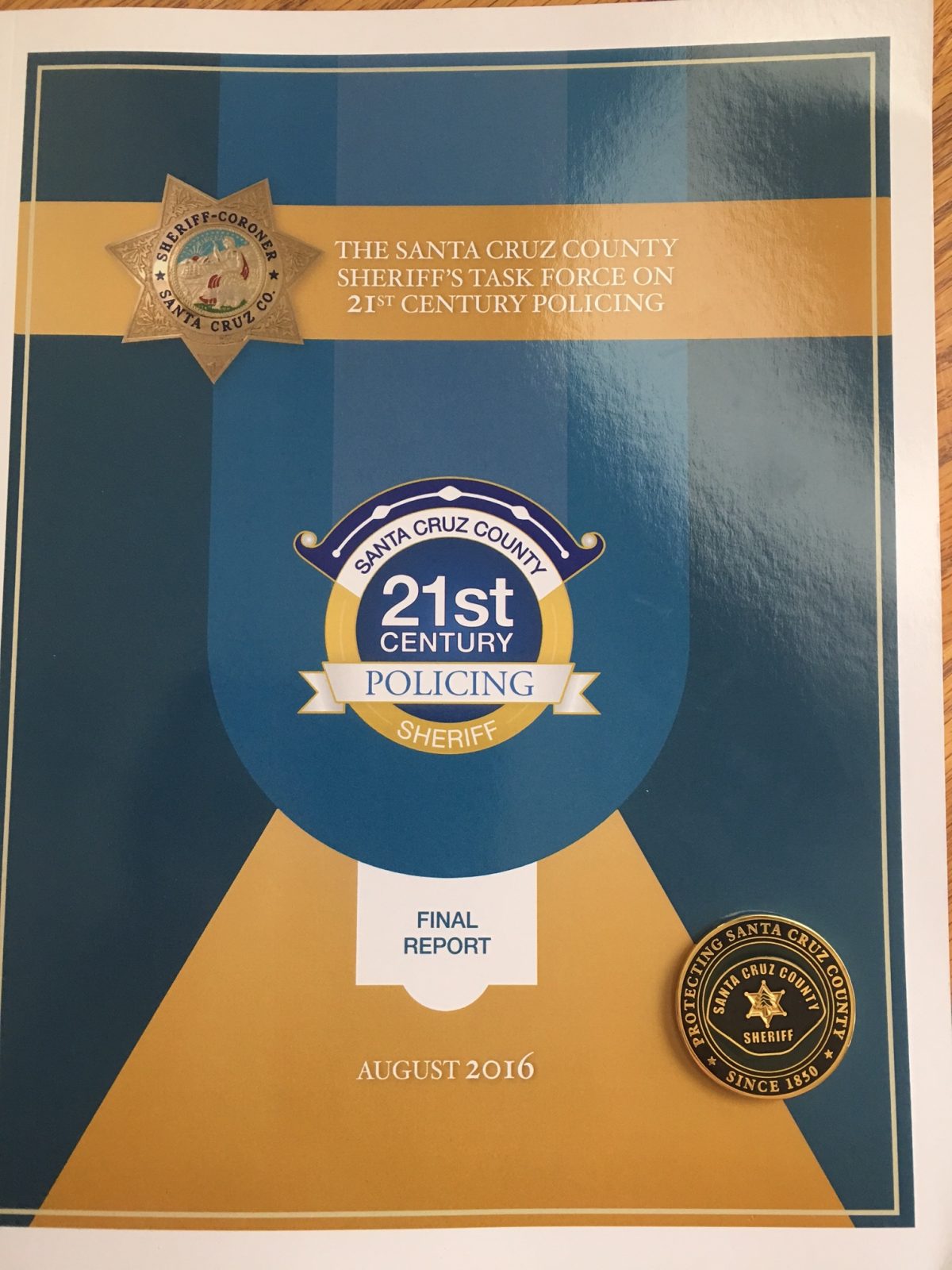
The Santa Cruz County Sheriff’s Department’s Final Report is online and linked below. If you live or work in Santa Cruz County, I strongly encourage you to read it for yourself. As you do, you should be questioning whether or not it makes sense to you. If you see something encouraging, acknowledge it and get involved if you can. If you see something that sounds like a load of BS, let the Sheriff know. After all, YOU are the community and the Sheriff is accountable to YOU. None of this works unless you speak up.

Finally, my thanks to the law enforcement professionals who are out there day in, day out, each and every day, working to keep us safe. Never has the job been more visible, more challenging or more dangerous. While it may not always feel like it, the community really is there behind you.

Bob

#oddstuffing, #21centurypolicing, #peelianprinciples, #scso, #santacruzcountysheriff, #bluelivesmatter, #mewe, #oddstuffing.com

Santa Cruz County Sheriff’s Task Force on 21st Century Policing

http://21stcenturypolicing.us/Portals/22/pdfs/FinalReport-21stCenturyPolicing.pdf

21st Century Policing

Preface: Last week I (foolishly) accepted a challenge to write a 250 word essay on what the most important part of 21st Century Policing is and why. The incentive for this is two essay authors will be invited to have lunch with Santa Cruz County Sheriff Hart at the Shadowbrook Restaurant.

This is the verbose, Odd Stuffing version. A much slimmer, 248-word extract was submitted by this morning’s 8 am deadline.

The link to the Final Report of the President’s Task Force on 21st Century Policing is at the bottom of the page.

—–

The title implies a couple of things, the adoption of high tech tools and techniques and a new way of policing. Integrating the latest & greatest technology is essential, however I reject the premise that there is a need to once again reinvent policing. The key to effective law enforcement is the community. It always has been and always will.

Police have come a long way from the original officers walking a beat. Talking to people on the street and in their shops was normal. Information was shared, issues averted and crimes solved. Growth and progress made communities larger and more difficult to effectively patrol. Automobiles gave us greater mobility and the ability to cover distance quickly, but separated the officer on the beat from the community. With it, the simple task of building one-on-one relationships with the community was gone.

With the loss of casual contact, the most common interaction with officers is through some kind of enforcement action. Getting out into the public, on the public’s terms instead of at department-sponsored events, allows communication on a more personal level. Only by stepping out of the primary enforcement role and into that of being a member of the community, can that one-on-one trust be established.

Law enforcement agencies should be a reflection of the communities they serve, each one a little unique as its constituents. At the core is the officers themselves. Many agencies prefer to hire younger, less experienced recruits so they can be molded into the proper culture. While this approach helps with a consistent mindset, it ignores the true diversity of knowledge and experience within the community. With limited non-law enforcement life experience, it may also promote an ‘us vs. them’ mindset. Agencies themselves can reinforce this by promoting policies, practices and perks that separate the officers from the communities and only serve to drive a wedge further between them.

The role of officers has also become more complex over the years. Officers are now expected to play the role of social worker, mental health, drug and marriage councilor, medic, educator, facilitator, consultant, guardian and warrior – all potentially within a single shift. The publics mandate for multidisciplined officers demands a far higher level of commitment to officer training and agency support than ever before.

The final report of the President’s Task Force on 21st Century Policing outlines six pillars for a modern, model law enforcement agency. These topic areas are: Building Trust and Legitimacy, Policy and Oversight, Technology & Social Media, Community Policing & Crime Reduction, Training & Education and Officer Wellness & Safety.

While a great piece of reference material with the full weight of the President of the United States behind it, it didn’t see any breakthrough ideas in it. The concepts of trust, transparency, technology, community policing, training, and so on have been around for a long time. The two main issues for agencies wanting to implement any of these recommendations are time and money.

Law enforcement is expensive and can range anywhere from 10 to 50% of a community’s budget. Every department is challenged by maintaining their current level of service with less funding, even as the community demands more services from them. Core functions such as patrol/enforcement and investigations are forever short staffed. Pulling personnel for other activities, even vital community relationship programs, which will have a positive impact on crime prevention, can have a ripple effect through the agency. Shifts and functions need to be covered with less people or left open. Grants can provide short-term program relief but not long-term operational support. Short of tax increases for larger budgets, the priority will always be for core enforcement functions.

This leaves agencies with difficult choices to make. To make gains in one area usually means cutting another. However, there is another possibility. When the walls between the agency and communities come down, additional options for cooperation and collaboration with the public and private enterprise emerge. Untapped resources for solving the community’s problems are available, when the agency is part of the community again.

Bob

#oddstuffing, #21centurypolicing, #whatsoldisnewagain, #bluelivesmatter, #mewe, #oddstuffing.com

http://www.cops.usdoj.gov/pdf/taskforce/taskforce_finalreport.pdf