
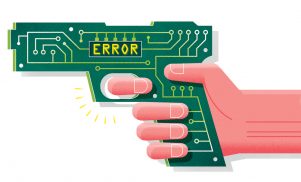
Bond… James Bond. When it comes to high tech gadgets, nobody does it better than 007. Through the Bond movies we’ve seen cars that fly, swim and are invisible, jet packs, mini-rocket cigarettes, watches with lasers powerful enough to cut through inches of steel and of course, a signature gun – a gun that can only be fired by the owner.
While many of the Q inspired gadgets are pure movie fiction, some have come to exist in the real world, but with real world limitations. A couple of cars can fly, but they don’t look anything like a regular car. Some cars swim, but they are the odd ducks of the auto and boat world and they can’t go under water. And then there are signature guns, now called “smart guns” by those who believe they are the next greatest gun safety, a.k.a. gun control measure.
The technology has been around for years and generally relies on a ring, watch or band that must be held in close proximity to the firearm to activate it. The theory is if the owner is not holding the firearm with the appropriate activation device, it will not fire. The only current production firearm is a .22 LR pistol made by a German company, which uses a radio frequency identification (RFID) chip and requires a five-digit pin code for an eight-hour activation period. It is not currently available in the United States. A few tech entrepreneurs have jumped on the bandwagon and are working on prototypes with remote controls, electronic ammunition and RFID chips embedded in the firearm owner’s skin. Firearms with pin codes, fingerprint readers, sensors to identify the owners grip, Bluetooth activation and Internet connected schemes are out there as well.
Despite the lack of demand from firearms community, it is being legislated as a requirement. The President’s latest set of Executive Orders included a provision for federally funded research into “smart gun” technology. A 2002 New Jersey law stipulates that three years after “smart guns” are available anywhere in the United States only smart guns can be sold in the state of New Jersey.
It’s worth noting the National Shooting Sports Foundation (NSSF) and the National Rifle Association (NRA) have both been very clear that they are not opposed to “smart gun” technology. What they are opposed to, and I firmly agree, is a government mandate for it. If the market decides they want it, then the products will flourish.
What could be wrong with a “smart gun”? In a word: technology. Aside from the issues of adding sensitive electronics to a machine with heavy shock and vibrations; batteries die and usually at the worst possible time. Add a little moisture, heat or cold and they’ll die quicker. Radio frequency connections are not only highly prone to interference but hacking as well. Being tethered to a device of any kind means you must always be wearing that device on the hand you will be shooting with. Take it off and you’ve got access to an ugly little brick. If you’re wearing gloves or have dirty hands with devices that check fingerprints, you’ll be out of luck.
In the research I’ve done (yes, I really do research) the inherent unreliability isn’t the worst part. The most frightening part is what is hidden inside the “smart gun” technology. Two core features are part of nearly all “smart gun” technologies; GPS and remote deactivation. GPS integration allows tracking of the firearm at all times, similar to your cell phone. Remote deactivation allows you, or someone else to remotely disable your firearm. That alone should scare the pants off you. At any time your family, employer or coworker – under California’s latest proposed enhancement to the Gun Violence Restraining Order law – could file a complaint against you and your firearms can be deactivated without your knowledge.
The real danger surfaces when those two features are combined. Similar to GPS software in newer drones, geofencing allows a virtual barrier to be placed around sensitive areas disallowing operation. The most common areas for drone operators are airports. Now move this into firearms restrictions. Government buildings, Post Offices and courts are the first to come to mind. But what about schools? Since anything within 1000 feet of a school is already a federally defined gun free zone, your firearm won’t work there. If you live within 1000 feet of a school – guess what, the Second Amendment won’t apply to you. Certainly banks will want to get in on the safety of geofencing their property. Who would need to use a firearm at an ATM?
Now consider a riot, protest or disturbance of any kind in your neighborhood. The beauty of connected systems is a geofence can be set up anywhere, anytime. The first action taken to an incident in your neighborhood can easily be a gun-free geofence set up around it to protect the first responders. It won’t matter if you are the one lawfully defending yourself at the time, all “smart guns” will be shut down.
Here’s the funny thing about so-called “smart guns”: The ONLY people who this will impact will be the law abiding citizen who wants to protect themselves or their family using their Second Amendment rights. It will have ZERO impact on criminals who will be using the plain old-fashioned pull-the-trigger-and-it-fires firearm that the rest of the world will still produce and can smuggle into the United States.
Firearms are supposed to do one thing and one thing only, reliably and accurately send projectile out the end of the barrel each and every time the trigger is pulled. Anything that has even the remotest possibility of preventing that from happening is a threat to your life. Safety, security and marksmanship are the sole responsibility of the owner, not a computer chip.
Is a “smart gun” right for you and your family? If so, that should be your choice, and your choice alone. If you prefer to have the regular, reliable kind of firearm then that should be your choice also, not the government’s.
Bob
#oddstuffing, #2ndamendment, #smartguns, #guncontrol, #gunconfiscation
Remember the updated malfunction drill: Tap, rack, check GPS, change battery, run setup, re-sync, bang.