
As you may recall I foolishly accepted a Facebook challenge to write an essay on what the most important part of 21st Century Policing is and why. The prize for the two winning authors was to have lunch with Santa Cruz County Sheriff Hart. Much to my surprise, my essay was one of the two selected. It took a while to get scheduled but I finally had lunch with Sheriff Hart and Danielle, the other winner, at Café Cruz.
Before you ask, even though I am a very vocal advocate of Second Amendment rights and write about them often, there is a time and place for that conversation and this was neither. I still hope to have that conversation with the Sheriff sometime, but this wasn’t the time for it. We talked about the 21st Century Policing program in Santa Cruz County as well as our own experiences and feelings towards law enforcement in the community. Long story short, I was encouraged by the Sheriff’s motivations, commitment to transparency and the steps he has taken to date. Of course there is still much to do.
Let me back up a little to the President’s Task Force on 21st Century Policing. President Obama put the Task Force together in response to the protests and riots in Ferguson, Missouri following the fatal shooting of a black man by a white police officer in August 2014. No charges were brought against the officer, however the U.S. Department of Justice did find fault in the Ferguson Police Department’s policies. The Task Force’s final report came out in May 2015.
If the fact that this study was done as a consequence of Ferguson causes you some concern, you’re not alone. Political responses to violent incidents tend to be knee-jerk and one-sided, something we in California are very accustomed to. Combine this with the fact it was commissioned by an administration with less than stellar support of law enforcement in racially charged incidents and you get a little suspicious from the get-go. As such, a lot of the report’s content focuses on racial and community relations. That of course is fair. Regardless of how any racial tensions were initiated or escalated in this country or who was responsible for it, the fact that they are here means that they need to be addressed.
As I expressed in the previous article, the concept of community policing isn’t new, it’s been around for decades as a formal program and forever as a concept, with the origin dating back to the “Peelian Principles”. Developed by Sir Robert Peel in 1829 to define an ethical police force, it is commonly known as policing by consent. The key element in all of this is cooperation between the public and the police.
Fast forward to today. Public perception of law enforcement is not always positive, occasionally justified, most often times not. The evolving nature of law enforcement and the massive expansion in responsibilities and duties of officers everywhere places a huge demand on them and the system. The focus shifts away from cooperation with the community, and that relationship, the basic foundation of the function, suffers.
Of the 21st Century Policing criticism I’ve heard is it focuses more on the touchy-feely stuff and not enough on fighting crime. I get that. Given a choice between kicking down doors and putting the habeus grabus on bad guys and spending the afternoon talking to residents and small business owners, most officers are going to take the bad guy every time. But modern, as well as traditional and historic law enforcement is much more than that. It’s the bond with the community that makes the job successful.
It is important to note that the 21st Century Policing pillars are not a policy manual for a law enforcement agency. They are only recommendations and they are voluntary. What works in one community may not work in the next. It does not mean codling criminals or less assertive enforcement. It does mean working with the community to tailor the mission to the needs of the community. And if you take a look at the diversity of Santa Cruz County, that’s not an easy task.
I’ll say it again; the key to effective law enforcement is the community. It always has been and always will. Effectively reaching the community is best done one-on-one, one person at a time. It doesn’t happen over night and there are times when you take one step forward and two steps back. It’s a long-term commitment, but it is the right way to do it.
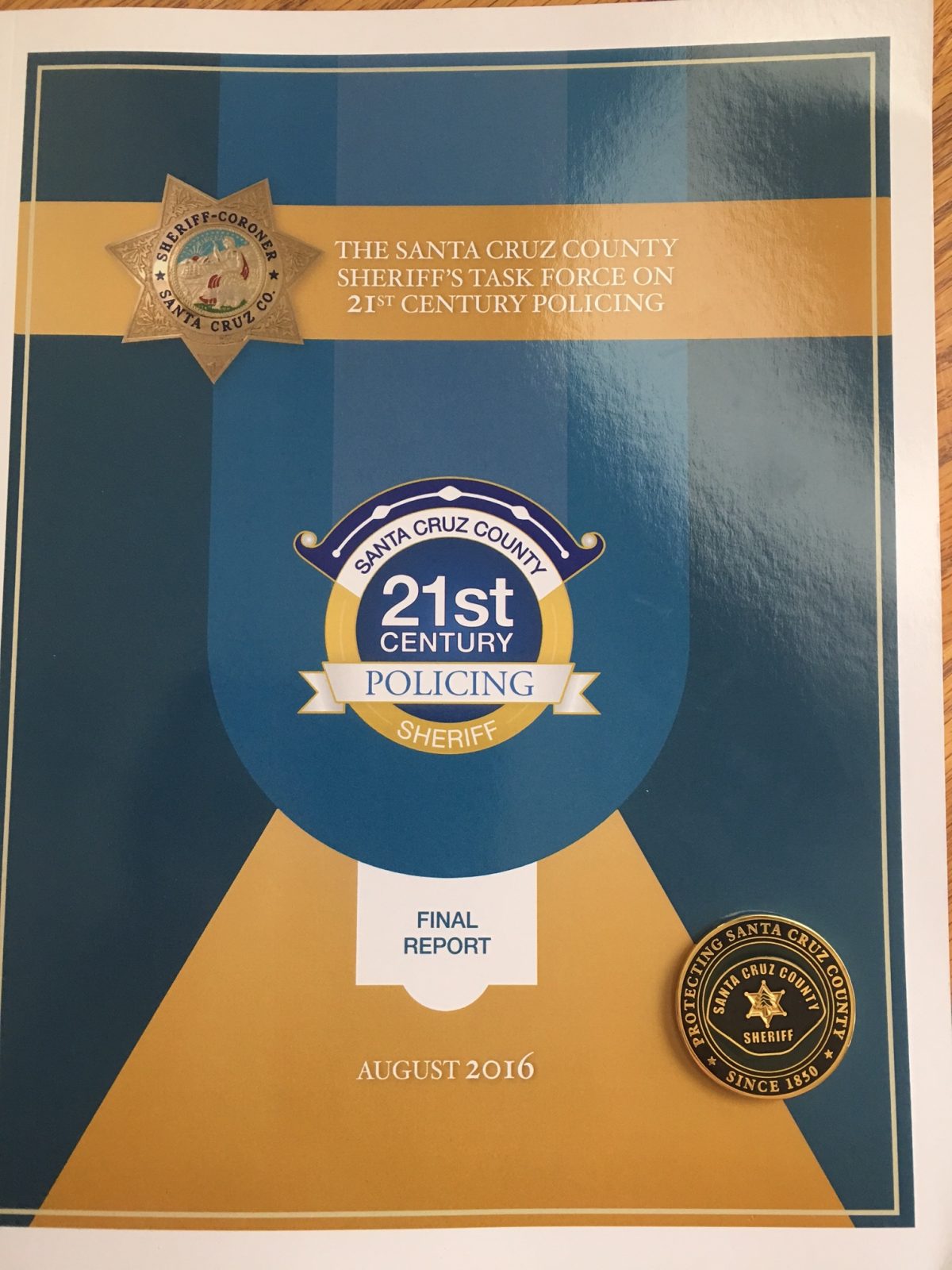
The Santa Cruz County Sheriff’s Department’s Final Report is online and linked below. If you live or work in Santa Cruz County, I strongly encourage you to read it for yourself. As you do, you should be questioning whether or not it makes sense to you. If you see something encouraging, acknowledge it and get involved if you can. If you see something that sounds like a load of BS, let the Sheriff know. After all, YOU are the community and the Sheriff is accountable to YOU. None of this works unless you speak up.
Finally, my thanks to the law enforcement professionals who are out there day in, day out, each and every day, working to keep us safe. Never has the job been more visible, more challenging or more dangerous. While it may not always feel like it, the community really is there behind you.
Bob
#oddstuffing, #21centurypolicing, #peelianprinciples, #scso, #santacruzcountysheriff, #bluelivesmatter, #mewe, #oddstuffing.com
Santa Cruz County Sheriff’s Task Force on 21st Century Policing
http://21stcenturypolicing.us/Portals/22/pdfs/FinalReport-21stCenturyPolicing.pdf